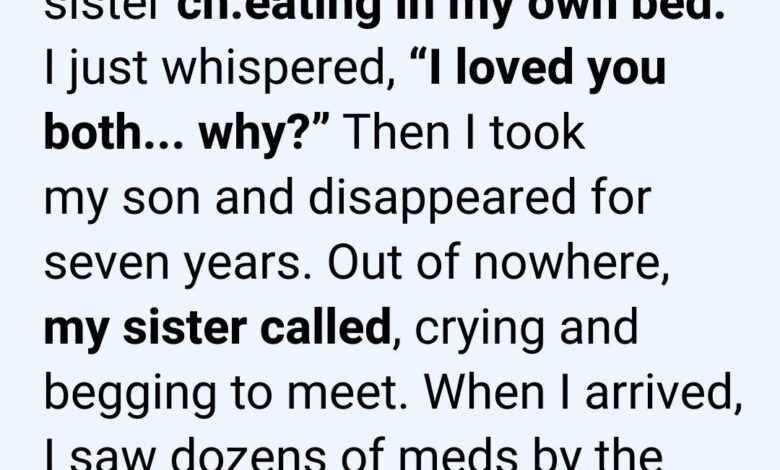
I walked into that cramped, dimly lit apartment carrying seven years of distance like a suit of heavy armor. Every step across the threshold felt rehearsed, and every breath I took was guarded, as if the very air of the room might poison the resolve I had spent nearly a decade building. In the quiet theater of my mind, I had imagined this moment countless times. In those fantasies, my anger was always sharpened into something clean, cold, and decisive. I expected to face a couple who had thrived in the wake of their betrayal, two people who had built a prosperous life on the ruins of mine. I was prepared to confront their triumph with my righteous indignation. Instead, what I found was not a victory, but a total collapse. The two people sitting before me were undone by the weight of their own history, stripped of the arrogance and certainty that had once defined them.
My husband was a ghost of the man I remembered. Illness had hollowed him out with a cruel efficiency, leaving behind a fragile, unfamiliar frame that looked as though it had already begun the process of saying goodbye to the world. My sister sat beside him, her eyes rimmed with the telltale shadows of sleeplessness and a deep-seated shame. Her posture was bent inward, a physical manifestation of a desire to disappear entirely from the light of day. The room itself was thick with the heavy, suffocating stillness of regret. No one offered an excuse. No one reached out with a rehearsed plea for mercy or tried to justify the act that had once shattered my universe. There were no grand speeches, only a quiet, devastating acknowledgment that their current state was the direct consequence of the path they had chosen seven years prior.
Between us lay a small bank card, and as I picked it up, it felt far heavier than a slip of plastic should. It represented a sum of money they had painstakingly saved, not for their own comfort or medical bills, but for my son. It was a wordless, belated apology for the years I had weathered alone—the years spent working multiple jobs, the nights spent staring at the ceiling wondering how to rebuild a life from scorched earth, and the exhaustion of raising a child without the partner who had promised to be there. It was an offering made far too late to change the past, yet its sincerity was undeniable. In that moment, the choice was mine. I could have taken the card, walked out the door, and left them to the fate they had earned. No one in the world would have blamed me for turning my back. My bitterness was justified; my anger was a debt that had never been paid.
Instead, in a moment that defied my own logic and surprised the very core of my being, I chose a different path. I decided to use that money to fight for the man who had systematically broken me. This decision did not spring from a sudden surge of affection or the restoration of a trust that had been permanently incinerated. It came from a place of profound exhaustion. I realized that I was tired of letting their betrayal dictate the rhythm of my heart. I was tired of carrying my anger like a trophy, as if the depth of my hurt was the only proof of my value. I realized that if I continued to define myself by what they had done to me, I was still a prisoner in that bedroom where my life had first collapsed. I wanted my future to belong to me again, and I realized that the only way to own it was to let go of the debt.
Forgiveness did not arrive as a cinematic embrace or a grand declaration of peace. It arrived quietly, almost imperceptibly, in the daily, practical choices I began to make. It showed up in the tedious paperwork of medical insurance, the sterile atmosphere of hospital waiting rooms, and the long, exhausting hours spent coordinating the care required to keep a dying man alive. Through a slow and grueling process, treatment began to rewrite his prognosis, even if it could never rewrite our history. He eventually recovered enough to live, enough to participate in the life of the son he had nearly abandoned, and enough to sit every day with the full, unvarnished weight of his past actions.
We never returned to the way things were before the betrayal. Some things, once shattered, simply do not return to their original shape, and it is a fantasy to believe they should. Our relationship remained defined by a necessary distance and firm boundaries, but the narrative of my life was no longer stuck on that one terrible night of discovery. There was finally an ending beyond the pain—an ending that included survival, a strange kind of accountability, and a future that was no longer ruled by the ghosts of what had been lost. I had stopped waiting for an apology that could never be loud enough and started living a life that was large enough to contain the hurt without being consumed by it.
My son remains unaware of the specific details of that dark chapter. He does up grow up without the poison of the betrayal or the knowledge of the depth of the loss his mother endured. What he does know, however, is a much more important lesson: he watched his mother choose compassion when cruelty would have been the easier, more socially acceptable path. He saw me visit a man I had every reason to despise and offer him care instead of punishment. He witnessed consistency, responsibility, and a rare kind of restraint. That lesson in grace became his true inheritance, a spiritual and emotional foundation more enduring and valuable than any savings account could ever hope to be.
I have come to understand that forgiveness was never about the people who hurt me. It did not make their betrayal acceptable, nor did it render the years of my struggle unreal. It did not erase the scars or the memory of the silence I lived in while rebuilding my soul. What forgiveness actually did was loosen the rusted chain between what had happened to me and who I was allowed to become. By choosing mercy, I did not absolve them of their responsibility; they still have to live with the people they were. I simply refused to let their worst choices serve as the blueprint for the rest of my life. In the end, I did not set them free so much as I finally set myself free. I reclaimed my agency and my values, proving that the final word on my life would be written by my own hand, not by the hands of those who tried to break me.