THE CHAIR AT THE HEAD OF THE TABLE
THE CHAIR AT THE HEAD OF THE TABLE
By four-thirty on a rainy Thursday afternoon, downtown Chicago had turned silver.
Rain slid down the tall windows of the private bank on LaSalle Street, blurring taxis, umbrellas, and traffic lights into long streaks of blue-gray color. Inside, the weather seemed very far away.
The marble floors were dry.
The dark walnut counters were polished.
Brass fixtures glowed beneath warm ceiling lights.
Employees spoke quietly.
Clients lowered their voices without being asked.
Nothing in the building was loud.
Even money seemed to move more quietly there.
Jackson Reed had worked at the bank for fourteen months.
At twenty-five, he was still one of the younger employees on the main banking floor. He wore the same muted deep-green blazer every day, a light beige shirt, charcoal trousers, and brown leather shoes he polished every Sunday night.
His job title sounded more important than it was.
Client services associate.
Most days, that meant answering questions, helping customers fill out forms, directing appointments, locating account specialists, and occasionally calming people who had waited too long.
Jackson did not mind.
He liked people.
Not all people.
But enough of them.
His mother used to say he had inherited that from his father, who had spent thirty years repairing city buses and somehow came home knowing the life story of everyone who worked in the garage.
Jackson’s father had died three years earlier.
A heart attack.
Quick.
Unexpected.
One morning he was arguing with Jackson about whether the Bears would ever fix their offensive line.
By dinner, Jackson was sitting in a hospital hallway staring at a vending machine he could no longer remember how to use.
After that, Jackson found himself noticing older men differently.
How they paused before stairs.
How some pretended not to need help.
How pride sometimes looked almost identical to confusion.
He never talked about it.
But he noticed.
That Thursday was busier than usual.
A private-banking leadership meeting had been scheduled for five o’clock.
Jackson knew almost nothing about it.
Employees on his level rarely did.
He only knew that several senior executives were already upstairs, the private corridor had been reserved, and front-floor staff had been told to maintain a high standard of presentation.
Richard Cole had repeated that phrase twice during the afternoon briefing.
“High standard of presentation.”
Richard was Jackson’s floor supervisor.
Forty-six.
Tall.
Fit.
Ash-blond hair cut short.
Midnight-navy suit.
Wine-red tie.
Everything about Richard looked intentional.
His posture.
His haircut.
His watch.
His pauses.
He was not cruel.
At least Jackson had never thought of him that way.
Richard had simply spent too many years learning how people with money expected to be treated.
He noticed shoes.
He noticed watches.
He noticed whether someone walked through the door looking confident or uncertain.
He noticed whether clients said “my advisor” or “someone at the bank.”
And he treated those details as information.
Richard called it reading the room.
Jackson sometimes thought it was just judging people quickly enough to make the judgment feel professional.
At 4:42, the old man entered.
Jackson noticed him because nobody else did.
He came through the revolving doors alone.
Rain dotted the shoulders of his faded dark-olive overcoat.
He was thin, perhaps seventy-five, with silver-white hair, gray stubble, and a face that looked weathered rather than fragile.
In one hand he carried a dark-brown leather folder.
In the other, a folded piece of paper.
His shoes were old.
Not dirty.
Just old.
The kind of shoes someone repaired instead of replaced.
He stepped into the lobby and stopped.
People moved around him.
A woman in a cream coat walked toward the private-client elevators.
A man carrying an expensive leather briefcase crossed toward the teller stations.
Two employees passed near the entrance.
The old man looked toward the counters.
Then toward the customer-service desks.
Then toward the corridor leading to private banking.
He unfolded the paper.
Read it.
Looked up.
Folded it again.
He did not look frightened.
He looked annoyed with himself.
Jackson recognized that expression immediately.
The old man approached his counter.
“Excuse me… could you help me?”
Jackson looked up.
“Of course, sir.”
The old man placed the folded paper on the counter but kept one hand on it.
“I was told to come for a meeting.”
Jackson leaned forward slightly.
The writing was mostly hidden by the fold, but he could see enough to recognize the internal appointment format.
Private-banking level.
Executive corridor.
Jackson looked past the man toward the glass-and-walnut corridor on the far side of the floor.
“That should be through the private section.”
The old man followed his gaze.
“There?”
“Yes, sir.”
He nodded.
“Thank you.”
Jackson expected him to leave.
The old man picked up his brown leather folder and turned.
Then stopped.
He looked at the corridor again.
There were two glass entrances.
One led toward private account services.
The other toward executive conference rooms.
From where they stood, the signs were easy to miss.
The old man looked down at the paper again.
Jackson waited.
The man took several steps.
Then slowed.
Jackson came around the counter.
“Sir?”
The man turned.
Jackson pointed.
“The second glass door. Not the first.”
The old man nodded.
“Right.”
He started walking again.
Then paused.
Jackson could have gone back to his desk.
He should have.
Richard had been very clear that afternoon.
Front stations must remain covered.
But the bank was quiet.
The neighboring station was staffed.
No customers were waiting at Jackson’s counter.
And the old man still looked uncertain.
Jackson made a decision.
“Then let’s make sure you get there.”
The old man looked at him.
“You don’t have to do that.”
“It’s fine.”
Jackson stepped beside him.
They started across the marble floor.
The old man carried his brown folder close to his side.
“Busy day?” he asked.
Jackson smiled.
“Apparently.”
“Apparently?”
“I’m told there’s an important meeting.”
The old man glanced at him.
“And you don’t know what it’s about?”
“No, sir.”
“That must be difficult.”
Jackson laughed.
“Not really.”
“Why not?”
“Less to worry about.”
The old man smiled faintly.
Jackson liked him immediately.
Not because he was charming.
He wasn’t.
There was something almost severe about him.
But he listened.
Most people who asked Jackson questions were already preparing their next sentence before he answered.
This man actually listened.
They were halfway across the floor when Richard saw them.
He had just stepped out of the private-banking corridor.
His expression changed immediately.
Not dramatically.
Just enough.
His eyes moved from Jackson to the old man.
Then to Jackson’s empty counter.
“Jackson.”
Jackson stopped.
The old man stopped beside him.
Richard approached.
“Why are you away from your station?”
Jackson felt the familiar tightening in his chest.
“He has a private meeting.”
Richard looked at Harold.
Quickly.
Faded coat.
Old shoes.
Brown trousers.
No watch worth noticing.
No assistant.
No visible sign of wealth.
Then Richard looked at the folded paper.
He did not touch it.
“Private clients are handled by appointment upstairs.”
The old man answered calmly.
“That’s where I’m trying to go.”
Richard’s eyes returned to Jackson.
“Stop wasting time.”
Jackson stared at him.
Richard’s tone was quiet.
That almost made it worse.
“He has an appointment,” Jackson said.
“I heard you.”
“Then I’m just showing him the correct door.”
“You have a station.”
Jackson glanced behind him.
No clients were waiting.
The neighboring teller was helping one woman.
“I’ll be back in a minute.”
“That isn’t the point.”
The old man remained silent.
Richard continued.
“Your responsibility is the front floor. If a private client has an appointment, they know where to go.”
The implication was obvious.
The old man did not look like a private client.
Richard did not say that.
He did not need to.
Jackson felt embarrassed on the man’s behalf.
He also felt something else.
Anger.
Not much.
Just enough to make him hesitate.
Richard looked toward the old man again.
“Sir, regular account services are available on this floor.”
The old man studied him.
“I’m not here for regular account services.”
Richard gave a polite professional smile.
“Then someone upstairs can assist you.”
Jackson looked toward the second glass door.
It was less than thirty feet away.
“I’ll show you the door.”
Richard turned to him.
“You’re being reassigned from this counter.”
Jackson blinked.
“What?”
“Go to the back desk.”
Jackson stared.
The back desk.
No client interaction.
Internal paperwork.
Temporary assignments usually lasted the rest of a shift.
Sometimes longer.
Richard’s expression remained controlled.
“Now.”
Jackson felt heat rise into his face.
There were people close enough to hear.
Not many.
But enough.
A woman waiting near the service area glanced over.
Another employee suddenly became very interested in his monitor.
Jackson wanted to argue.
He almost did.
Then he looked at the old man.
The man’s expression had not changed.
No anger.
No embarrassment.
Just attention.
Jackson swallowed.
“Okay.”
He turned toward the back office.
The old man spoke.
“Son.”
Jackson stopped.
He looked back.
“Thank you for listening.”
Jackson gave him a small nod.
“You’re welcome, sir.”
Richard looked slightly impatient.
The old man turned toward the private corridor.
Jackson walked away.
He expected the moment to end there.
It didn’t.
The back desk was separated from the main floor by a half-height walnut partition.
Jackson could still see most of the lobby.
He logged into the computer.
Opened a stack of internal verification requests.
Read the first line three times without understanding it.
He was angry now.
Not enough to make a scene.
But enough that his hands felt warm.
He knew the rule.
Richard was not wrong that leaving a station without permission was technically a violation.
But Jackson had walked maybe forty feet.
There had been no line.
No waiting customer.
No emergency.
He had simply helped an elderly man find the right door.
And somehow Richard had turned that into a judgment about discipline.
Jackson hated the unfairness of it.
But what bothered him more was the reason.
He knew Richard.
If the old man had walked in wearing a tailored suit and a gold watch, Richard would have personally escorted him.
If a driver had followed him carrying an umbrella, nobody would have questioned his appointment.
If he had entered with confidence instead of uncertainty, Jackson would still be at his counter.
That realization stayed with him.
On the far side of the floor, the old man reached the private-banking corridor.
No one stopped him.
He passed through the glass doors.
Richard watched.
For a moment, Jackson thought the supervisor might follow.
He did not.
Instead, Richard returned to the floor and began checking customer-service activity as though nothing had happened.
Five minutes passed.
Then eight.
At 4:56, Richard checked his watch.
At 4:58, he stepped toward the executive corridor.
Jackson noticed because Richard had spent the entire afternoon preparing for the meeting.
He had reorganized the front staff schedule.
Checked the flowers in the private lobby.
Asked maintenance to wipe fingerprints from the glass twice.
Whatever was happening upstairs mattered to him.
At five exactly, Richard stood near the corridor entrance.
Waiting.
Jackson returned to his paperwork.
Then he heard a door open.
Not loudly.
Just the soft movement of heavy wood.
He looked up.
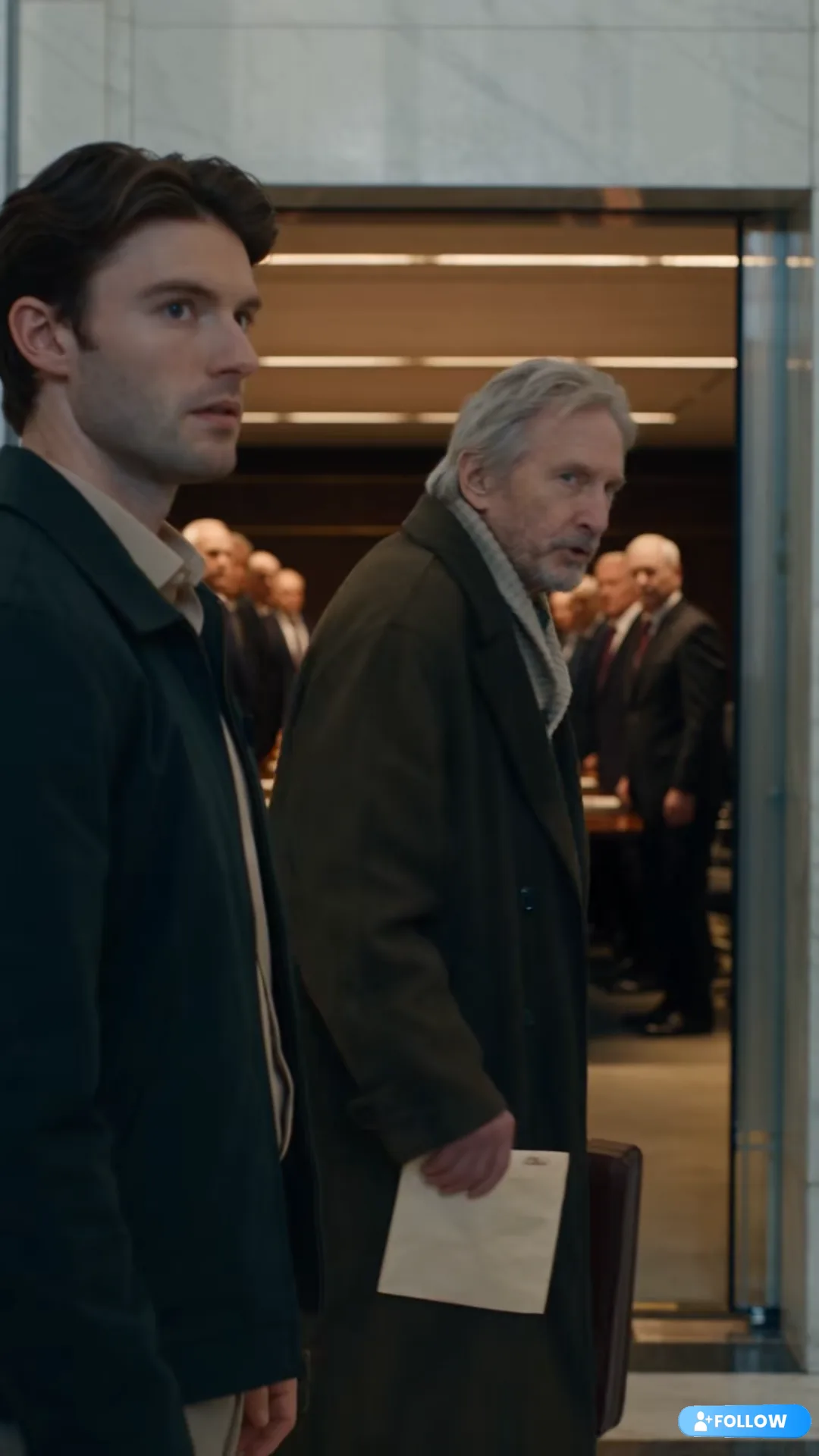
At the end of the private corridor, the executive boardroom door had opened.
The old man stood there.
Still wearing the faded olive coat.
Still holding his brown folder.
Nothing about him had changed.
But the room behind him had.
Jackson could see inside.
One long conference table.
Seven senior executives.
Men and women in conservative suits.
A black leather folder lay in front of one empty chair at the head of the table.
At first, all seven executives were seated.
One man near the middle looked toward the door.
He saw the old man.
His expression changed.
He stood.
Not quickly.
Not dramatically.
He simply stood.
The woman beside him followed his gaze.
She saw the old man too.
Then she stood.
Another executive looked up.
Then another.
Chairs moved softly against the floor.
One by one.
Without applause.
Without greeting.
Without anyone giving an order.
Every person around the table rose.
Jackson stopped breathing for a second.
Richard saw it too.
His posture stiffened.
There was something unmistakable about the way the room reacted.
Respect.
Not politeness.
Not customer service.
Not the automatic courtesy given to an elderly visitor.
Recognition.
The old man did not look surprised.
That was the detail Jackson noticed most.
Seven senior executives stood for him.
And he reacted as though nothing unusual had happened.
The empty chair at the head of the table remained visible.
The aged black folder sat directly in front of it.
Nobody occupied that seat.
Nobody moved toward it.
Until one senior executive stepped around the table.